
How Many Cruise Ships Have Sunk?
Since 1900, approximately 24 cruise ships have sunk — roughly one every four to five years. That number sounds alarming until you consider context: the cruise industry carries over 30 million passengers annually, and the overwhelming majority of sinkings occurred before 1940 when safety standards were far less rigorous. Since 2000, only four cruise ships have sunk while at sea with passengers aboard.
Cruising is genuinely one of the safest forms of travel. But the history is worth knowing — especially because several incidents contain remarkable stories of survival, heroism, and failure.
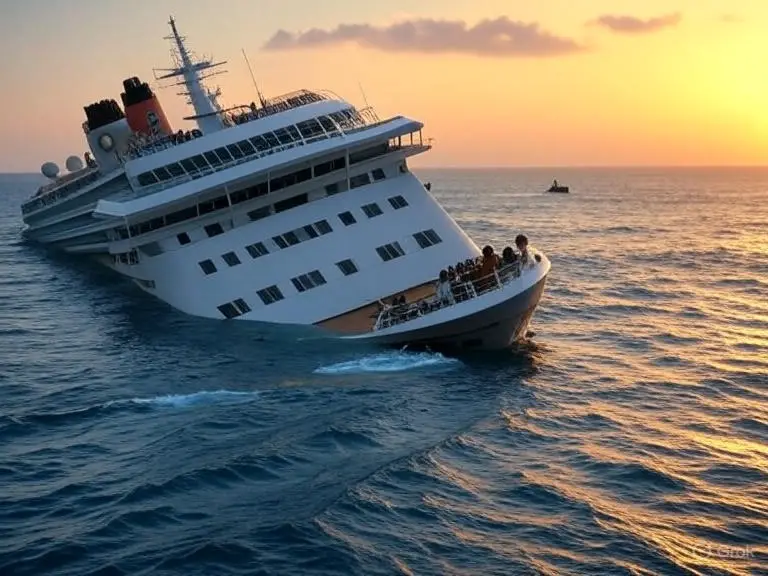
Notable Cruise Ship Sinkings — The Full Table
| Ship | Year | Cause | Deaths | Survivors |
|---|---|---|---|---|
| RMS Titanic | 1912 | Struck iceberg | 1,517 | 710 |
| SS Morro Castle | 1934 | Fire | 137 | 421 |
| SS Andrea Doria | 1956 | Collision with MS Stockholm | 46 | 1,660 |
| MV Bianca C | 1961 | Engine room explosion and fire | 1 | ~672 |
| MV Jupiter | 1988 | Collision with cargo ship | 4 | ~596 |
| MTS Oceanos | 1991 | Flooding / hull failure | 0 | 571 |
| Sun Vista | 1999 | Engine room fire | 0 | 1,090 |
| Sea Diamond | 2007 | Struck volcanic reef, Santorini | 2 | ~1,590 |
| MV Explorer | 2007 | Struck iceberg, Antarctica | 0 | 154 |
| Costa Concordia | 2012 | Struck reef, captain error | 32 | ~4,200 |
Note: The Titanic was technically an ocean liner, not a cruise ship, but is included given its cultural significance. Many earlier sinkings (pre-1940) involved vessels operating under significantly different safety standards.
The Stories Worth Knowing
Costa Concordia (2012) — The Captain Who Abandoned Ship
The most significant modern cruise disaster. The Concordia struck a reef off Giglio Island, Italy, after captain Francesco Schettino performed an unauthorized close pass to the island — known as a "salute." The impact tore a 160-foot gash in the hull. Schettino then abandoned the ship before evacuation was complete, ignoring direct orders from the Coast Guard to return. Thirty-two people died. Schettino was convicted of manslaughter and sentenced to 16 years in prison. The wreck was eventually salvaged in one of the most complex marine engineering operations in history and towed to Genoa for scrapping.
MTS Oceanos (1991) — When the Entertainers Saved Everyone
The Oceanos sank off South Africa in rough seas after a plumbing failure flooded the engine room. The captain and most senior officers abandoned the ship, leaving passengers to fend for themselves. The onboard entertainers — led by a husband and wife music duo — took over. They organized the evacuation, used the ship's radio to call for help, and coordinated helicopter rescues. All 571 people onboard were saved. Zero fatalities. It remains one of the most remarkable evacuation stories in maritime history.
Andrea Doria (1956) — The Last Major Ocean Liner Disaster
The Andrea Doria collided with the MS Stockholm in heavy fog off Nantucket. Despite carrying 16 lifeboats, only half could be launched due to the ship's severe list. The ship took 11 hours to sink, which gave time for rescue vessels to arrive and save 1,660 of the 1,706 people onboard. The 46 deaths occurred mostly from the initial impact.
MV Explorer (2007) — Perfect Evacuation in Antarctica
A small expedition vessel struck an iceberg in the Bransfield Strait. The hull breach was initially just fist-sized but proved impossible to seal. All 154 passengers and crew abandoned ship in lifeboats in one of the most remote locations on earth and were rescued by a passing Norwegian cruise ship. Zero fatalities — widely cited as a model evacuation.
Why Sinkings Are So Rare Today
The shift from the deadly pre-1940 era to the modern record reflects real changes in ship design and regulation. Modern cruise ships feature double hulls, watertight compartments that can be sealed remotely, fire suppression systems throughout the vessel, and stability systems that resist capsizing even in extreme conditions. The International Maritime Organization sets and enforces global standards — every ship must carry enough lifeboats for all passengers plus 25% extra, and muster drills are now mandatory before a ship leaves port.
The Costa Concordia disaster, despite being the worst in decades, resulted in significant industry-wide reforms: stricter navigation rules near coastlines, enhanced evacuation drills, and greater accountability for captains who deviate from approved routes.
For more on how modern ships handle extreme conditions, see: Can Cruise Ships Handle Rough Seas?
← Back to Cruise FAQsPlanning Your Cruise?
Find parking, hotels, and transportation guides for your departure port.