
- Rideshare beats taxi pricing about 70% of the time at U.S. cruise airports, but surge pricing on embarkation mornings—when thousands of cruisers request rides simultaneously—can make taxis the cheaper, more predictable option.
- Cities with flat-rate taxi zones (Miami, New Orleans, JFK) offer fixed fares immune to traffic and surge, making them especially valuable for cruise-day transfers.
- Solo travelers and couples generally save with rideshare, while groups of 4 or more with luggage often find taxis equally priced or cheaper.
- The article includes a 2026 cost comparison table for 16 major U.S. airport-to-cruise-port routes, showing base rideshare, surge rideshare, and taxi rates to help you budget accurately.
The Short Answer
At most U.S. cruise-related airports, rideshare is cheaper than a taxi roughly 70% of the time — but that number flips fast during peak hours, bad weather, or major events. The exceptions are cities with flat-rate taxi zones (New Orleans, San Francisco, parts of New York), where taxis are often cheaper and more predictable. For solo travelers and couples, rideshare almost always wins on price. For groups of 4+, especially with luggage, taxis frequently pull even or ahead.
That's the headline. The nuance — which airports have flat-rate taxi deals, where surge pricing routinely spikes, how luggage rules differ — is where this article earns its keep.
How Rideshare and Taxis Actually Price Your Trip
Before the city-by-city breakdown, it helps to understand why the two options behave so differently, because the answer isn't just "one is an app and one isn't."
Rideshare Pricing: Dynamic and Unpredictable
Uber and Lyft use dynamic pricing. The fare you see in the app reflects current supply and demand — how many drivers are nearby, how many people are requesting rides, time of day, weather, and whether a major event just ended. The base rate for an airport-to-cruise-port run is usually reasonable. But at 9 AM on a Saturday during peak cruise season, with three ships embarking at the same port, you can see that fare triple.
The app will show you the price before you confirm — but you're accepting that snapshot. If you cancel because it's too high and re-request 10 minutes later, it could be higher still, or lower. This is the trade-off for convenience: flexibility in both directions.
Taxi Pricing: Regulated and Predictable
Traditional taxi fares are set by local regulators. Some cities run meters (distance plus time). Others have designated flat rates for common airport-to-downtown or airport-to-port routes — meaning the fare is fixed no matter how long the ride takes. Flat-rate zones are cruiser gold: they're immune to traffic delays, immune to surge, and you know the price before you get in.
The trade-off is that when traffic is light and demand is low, taxis are often $10–$20 more than a rideshare would be. But at peak moments, they're often cheaper.
Airport-to-Cruise-Port Costs: Major U.S. Ports (2026)
Here's what you should actually expect to pay for each option at the airports that feed the busiest U.S. cruise ports. These are real 2026 rates, not historical averages. I've flagged surge risk based on how heavily each airport is used for cruise-day arrivals.
| Route | Distance | Rideshare (base) | Rideshare (surge) | Taxi |
|---|---|---|---|---|
| MIA → Port of Miami | 8 miles | $20–$28 | $35–$60 | $27 flat rate |
| FLL → Port Everglades | 3 miles | $12–$18 | $25–$40 | $15–$20 |
| MCO → Port Canaveral | 45 miles | $70–$95 | $110–$160 | $100–$130 |
| HOU → Galveston | 53 miles | $75–$100 | $130–$180 | $115–$140 |
| TPA → Port of Tampa | 5 miles | $15–$22 | $30–$45 | $20–$28 |
| MSY → New Orleans Port | 14 miles | $25–$40 | $50–$90 | $36 flat rate (1–2 pax) |
| SEA → Port of Seattle | 14 miles | $32–$45 | $60–$95 | $45–$60 |
| LAX → Port of LA (San Pedro) | 17 miles | $28–$45 | $55–$80 | $50–$65 |
| LGB → Port of Long Beach | 6 miles | $15–$22 | $28–$40 | $22–$30 |
| SAN → Port of San Diego | 3 miles | $10–$16 | $20–$32 | $15–$22 |
| EWR → Cape Liberty | 10 miles | $30–$45 | $60–$90 | $45–$60 |
| JFK → Brooklyn Cruise Terminal | 17 miles | $45–$70 | $90–$140 | $70 flat rate (meter) |
| BWI → Port of Baltimore | 14 miles | $25–$40 | $45–$70 | $40–$55 |
| BOS → Port of Boston | 4 miles | $15–$22 | $28–$45 | $22–$30 |
| CHS → Port of Charleston | 12 miles | $22–$32 | $40–$60 | $30–$40 |
| JAX → Port of Jacksonville | 15 miles | $28–$40 | $50–$75 | $40–$55 |
Rates are 2026 representative fares including standard tips. "Surge" reflects typical peak cruise-morning pricing (9 AM–12 PM on Saturdays during peak season). Taxi flat rates apply where noted; other taxi fares reflect metered estimates.
Flat-Rate Taxi Cities (Where Taxis Routinely Win)
A handful of airports serving cruise ports have flat-rate taxi zones that make the math easy. In these cities, the taxi price is locked in before you get in the car — no meter, no surge, no surprise.
New Orleans (MSY) → New Orleans Cruise Terminal
The flat rate from MSY to the Central Business District (which includes the Erato Street cruise terminal and Julia Street terminal) is $36 for 1–2 passengers, with additional per-passenger fees. This is one of the clearest wins for taxis at any U.S. cruise port. The rate holds regardless of traffic, event, or time of day. During Mardi Gras, Jazz Fest, and other peak weeks, rideshare fares to the same destination can triple. If you're cruising from New Orleans, take a taxi.
Miami (MIA) → Port of Miami
MIA operates a flat-rate zone system. The official flat rate to the Port of Miami is around $27. Rideshares are often cheaper in the base case — but during peak embarkation windows, the flat taxi rate wins by $10–$30. For groups of three or more, taxis also avoid Uber's XL surcharge.
New York JFK → Manhattan/Brooklyn
JFK has a long-standing $70 flat rate to anywhere in Manhattan (plus tolls and tip). For the Brooklyn Cruise Terminal specifically, the rate runs meter, but it's still typically cheaper than surge-priced rideshare on a cruise Saturday.
When Rideshare Wins
Short, straightforward routes during off-peak hours are rideshare's sweet spot. FLL to Port Everglades is a classic example — a 3-mile run where base rideshare costs are genuinely low ($12–$18) and the route is too short for surge to inflate dramatically. Tampa, San Diego, and Long Beach are similar: short airport-to-port distances where rideshare is simply cheaper.
Off-peak arrivals favor rideshare too. If you're flying in the day before your cruise and landing at 6 PM on a Friday, there's no cruise-morning surge to worry about. Rideshare's base rate is usually your cheapest option.
Solo travelers and couples benefit most. Rideshare's pricing doesn't change based on party size (until you hit the 5+ passenger vehicle upgrade), while most taxis have per-person fees or are priced per-trip for small vehicles. For one or two people with moderate luggage, rideshare is usually the best value.
When Taxis Win
Peak cruise-morning surge windows consistently favor taxis. The worst rideshare surge I've seen reported at Port of Miami ran close to $80 for a ride that normally costs $22. The taxi at the same moment was the published flat rate. If you're arriving between 9 AM and noon on embarkation day, especially at a port with multiple ships departing simultaneously, taxis become the predictable choice.
Large groups. A taxi or taxi van can carry four passengers with luggage for the same fare a single-rider rideshare would charge. When you factor in Uber XL or Lyft XL premiums, four adults with bags often come out $15–$30 ahead in a taxi.
Oversized luggage. Most rideshare vehicles are sedans. If you're traveling with three large checked bags plus carry-ons for two people, you're either cramming the trunk shut or ordering an XL vehicle (which adds $15+ to the fare). Taxis — particularly airport-queue taxis — are often larger vehicles by default, and most airports include minivan taxis in the rotation.
When the app is struggling. Rideshare apps occasionally glitch in crowded airport pickup zones. Signals are weak, drivers cancel because they can't find you, pins drop in the wrong garage level. Taxis don't require an app. You walk to the taxi queue, you get in a taxi.
The Hidden Costs Nobody Talks About
Airport Pickup Surcharges
Virtually every major U.S. airport charges a per-ride fee on both rideshare and taxi pickups — usually $3–$6, passed to the passenger. It's baked into the quoted fare, but it's why airport rides always start $5 higher than the same distance across town.
Long Wait Times
Rideshare pickup at airports has gotten more complicated, not less. At most airports, rideshare pickup is at a designated lot or a specific terminal level, sometimes requiring an escalator ride and a 5-minute walk. MSY's rideshare pickup is on Level 3 while taxis wait on Level 1 — a real consideration if you have mobility limitations or a lot of bags. Orlando, Los Angeles, and Seattle all have rideshare lots that require a 5–10 minute walk from baggage claim.
Taxi queues at airports usually run directly curbside to baggage claim. You're often in a taxi before a rideshare has even been matched.
Cleaning Fees and Damage Disputes
A traveler spills something, the driver reports a cleaning fee, Uber charges $75–$150 to your card without your approval. This is rare, but it happens — and disputes are tedious. Taxis don't have this system. You pay what's on the meter or the flat rate.
Surge Multipliers During Events
Major events near an airport or cruise port spike surge pricing. Super Bowl weekend in Miami. Mardi Gras in New Orleans. Major conventions in Seattle. Spring break in Florida. All of these push rideshare to 2–3x normal. Check local event calendars before deciding which option to take.
Safety, Insurance, and Accountability
Both options are generally safe, but there are differences worth understanding:
Rideshare: Drivers are pre-screened by Uber and Lyft. Rides are GPS-tracked. You can share your trip in real-time with someone. The driver's name, vehicle, and license plate are in the app. Insurance coverage is provided by Uber/Lyft while the driver is on an active trip.
Taxi: Drivers are licensed by the city or county. Vehicles are inspected on a regulated schedule. Medallion numbers are visible. Airport taxi queues are monitored by airport authorities.
Neither option is notably riskier than the other from legitimate, airport-authorized queues. The danger lies in unauthorized transportation — people in the arrivals hall approaching you offering rides. Don't take those, ever, at any airport.
What About the Return Trip?
The calculation shifts on disembarkation day. Here's why:
You disembark at 7:30–9:30 AM along with thousands of other passengers. Everyone is trying to get to the airport at the same time. Rideshare surge at the cruise port on disembarkation morning is often worse than airport-to-port surge on embarkation day. And because taxi queues at cruise ports are often thinner than at airports, you might wait longer for a cab than usual.
For the return trip specifically:
- Pre-book a taxi or transfer service if your flight is tight. Price certainty matters when a missed flight means a real re-booking problem.
- Avoid disembarking at the peak if possible. Many ships offer "self-assist" early walk-off at 7 AM. If you can handle your own luggage, this gets you to the transportation queue before the crowd.
- Check the cruise line shuttle. On disembarkation day, cruise line airport shuttles sometimes become competitive with rideshare surge. Not always, but worth a quick price check.
My Decision Framework
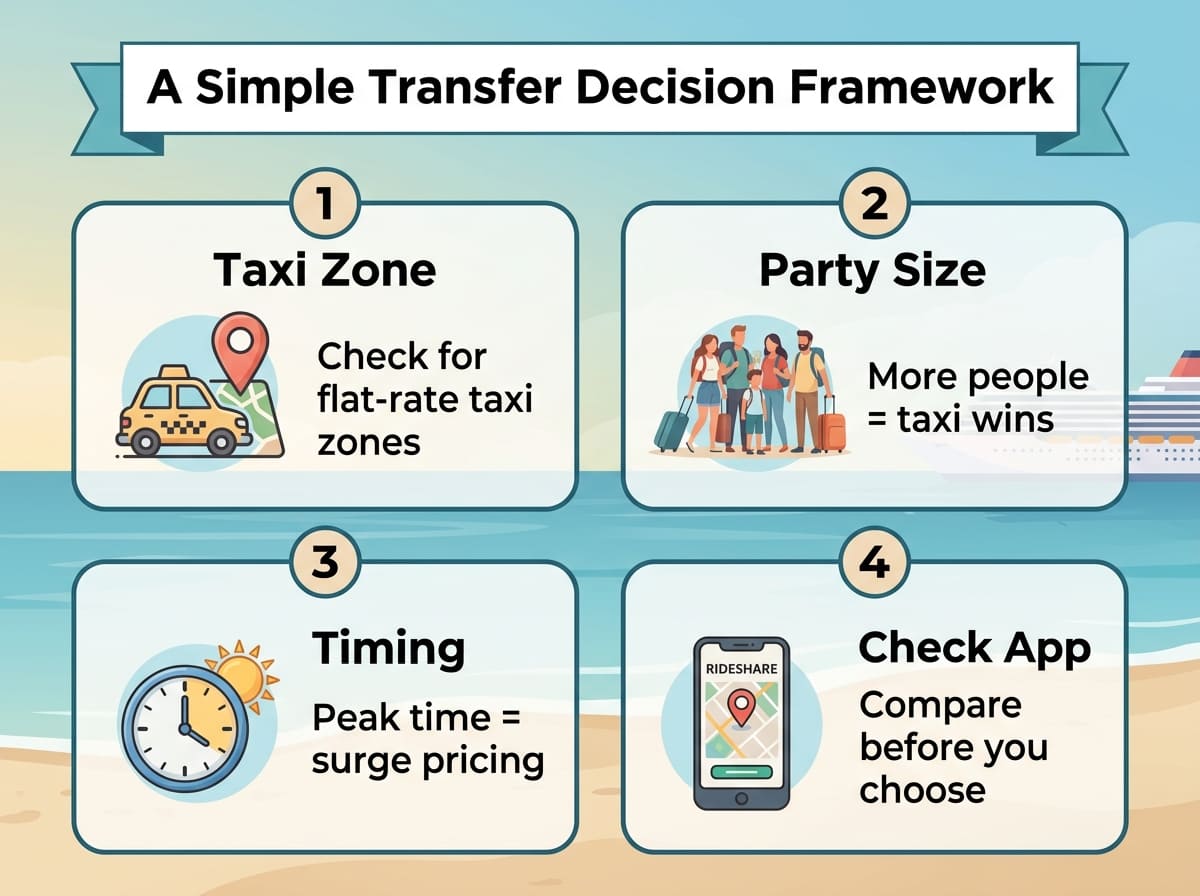
Here's how I'd think about it for any cruise:
- Check if your airport has a flat-rate taxi zone to the cruise port. If yes, and you're arriving during peak embarkation hours, the taxi is likely the predictable, cheaper option.
- Count your party size. Solo or couple? Rideshare. Group of 4+ with luggage? Taxi or taxi van almost always wins.
- Check the timing. Arriving on embarkation morning during peak season? Factor surge. Arriving the day before in the evening? Rideshare base rates are usually unbeatable.
- Open the rideshare app at the airport before you walk to the queue. Takes 10 seconds. If the surge is bad, walk to the taxi queue instead.
That last tip is the simplest one in this article and the most valuable. The rideshare price lives in your pocket. Use it as a data point, not a default.
Port-Specific Picks
Take a taxi: New Orleans, Miami (during peak), Brooklyn (during peak), Seattle (during peak summer).
Take rideshare: Fort Lauderdale, Tampa, San Diego, Long Beach, Boston, Charleston, Jacksonville.
Depends on timing: Port Canaveral (MCO is 45 miles — distance makes this pricey either way, so compare before you ride), Galveston (HOU/IAH are far — pre-booked transfers often beat both).
For airport-to-port logistics specific to your departure city, see our individual port transportation pages — each one lists current rates, pickup locations, and the best option by time of day.
Frequently Asked Questions
Is Uber or Lyft cheaper for airport-to-cruise-port trips?
Usually within a few dollars of each other. Check both apps before confirming. Lyft tends to have slightly lower base rates; Uber has better driver availability at most major airports. For one-off cruise trips, price-check both — the cheaper option varies by day.
Can I take a taxi or rideshare directly to the ship?
Yes, at every major U.S. cruise port. Taxis and rideshares drop off at a designated passenger loading zone near your terminal, where porters take your bags and you proceed to check-in.
Should I tip a rideshare driver? A taxi driver?
Yes, both. Standard tips are 15–20% for good service. Rideshare tips can be added in-app after the ride. Taxi tips are cash or added to the credit-card slip.
What if my flight is delayed and I miss my rideshare?
No problem. Rideshare rides aren't pre-booked (unless you scheduled them in advance) — you request when you land. Taxi queues don't require reservations either. The issue is only with pre-booked private transfers, where you need to notify the company of the delay.
Can a rideshare pick me up at any airport terminal?
No. Every major U.S. airport has designated rideshare pickup zones, which may not be at your terminal. Check the Uber/Lyft app for pickup instructions specific to your airport before you head to baggage claim.
What about airport shuttles or cruise line transfers?
These are separate options with different trade-offs. Cruise line transfers are predictable but expensive (often $25–$50 per person one-way) and leave only on specific schedules. They're most useful for solo travelers with tight flight-to-ship timing. Airport shuttles are a distant third option for most U.S. cruise ports. See our guide to free cruise port shuttles for which cities have genuinely useful shuttle options.
The Bottom Line
The rideshare vs. taxi decision isn't really about which service is "better" — both are fine, both are safe, both get you to the ship. It's about understanding when each one prices out in your favor, and being willing to check before you commit.
Five seconds in the rideshare app tells you whether surge is active. One glance at the taxi queue tells you whether a flat rate applies. Those two data points, taken together, are worth $30–$60 on embarkation morning across most U.S. cruise ports. It's the easiest savings in cruise travel — you just have to actually look.
Related reading: Airport to Cruise Port: Transportation Guide for Every Major Port · Free Cruise Port Shuttles: Complete Guide by City · Hotel Shuttle vs. Uber: Getting to Cruise Terminals