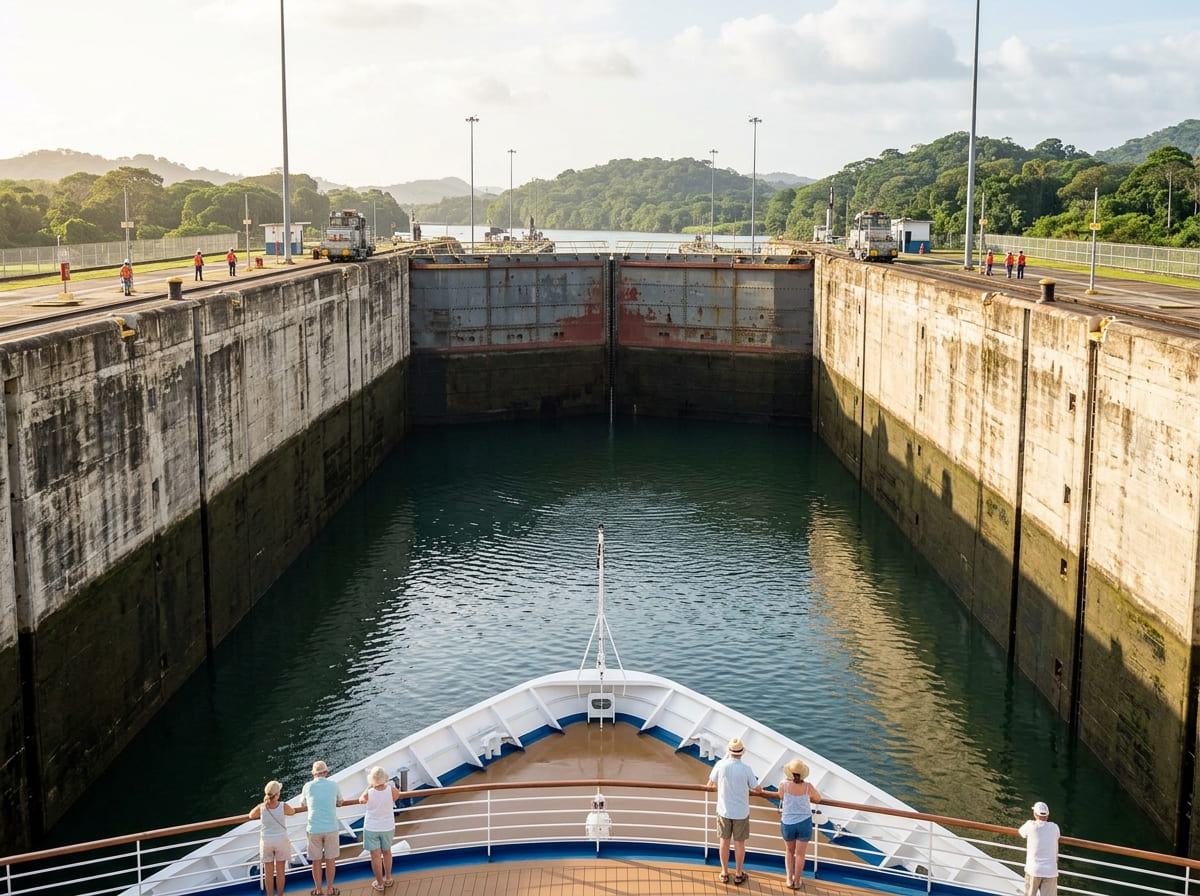
- Cruise ships will not wait for late passengers, and missing embarkation typically means losing your entire cruise fare ($2,000–$5,000+) with no refund.
- Flight cancellations, missed connections, traffic delays, and long check-in lines are common reasons travelers miss their ship on embarkation day.
- Arriving the night before and staying at a hotel ($150–$250) is widely considered the cheapest insurance against losing your entire vacation investment.
- An extra day also provides a buffer to resolve last-minute document or ID issues like expired passports or reservation name mismatches.
The Rule Every Experienced Cruiser Knows
Ask ten experienced cruisers what advice they give first-timers, and nine of them will say the same thing: arrive the day before your cruise. Stay overnight. Don't try to travel in on embarkation morning.
Cruise industry people call this the "one day rule." It's the single most universally agreed-upon piece of cruise advice, and it's the one that saves vacations every single week. Miami, Galveston, Seattle, Anchorage, Bayonne — somewhere in the U.S., every weekend, multiple parties miss their cruise because they tried to travel in on the day of embarkation and something went wrong.
The hotel cost is the barrier that stops most first-timers from following the rule. $150 to $250 feels like a lot of money to "waste" on an extra hotel night. But compared to the cost of what can go wrong if you cut it close, that hotel night is the cheapest thing you'll pay for on the entire trip.
What Actually Goes Wrong on Travel Day
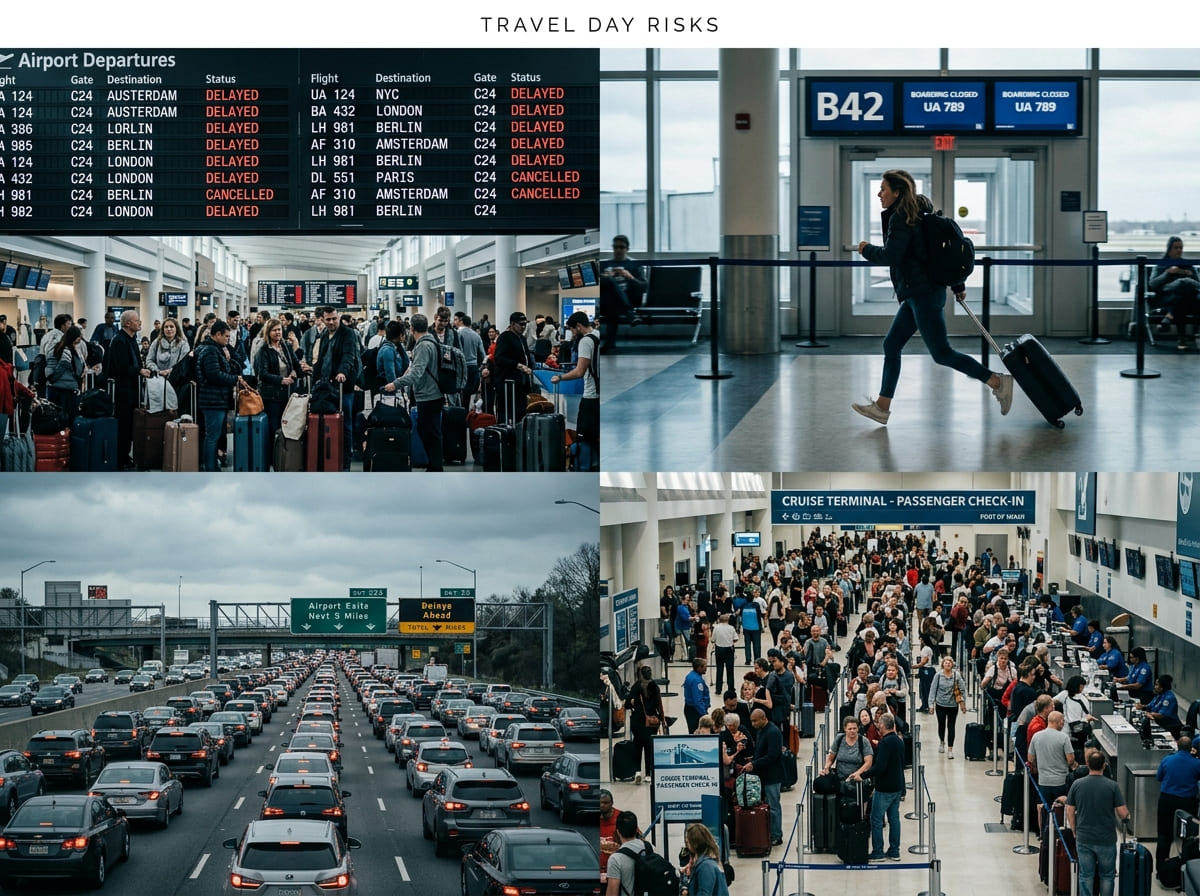
The abstract reason to arrive early is "delays can happen." The specific reasons are more concrete and worth knowing.
Flight Cancellations and Delays
U.S. airlines cancel roughly 2–3% of scheduled flights on any given day. That number spikes dramatically during weather events, air traffic control issues, or airline operational disruptions. Your 8 AM flight to Miami that's supposed to land at 11 AM can easily become a 2 PM arrival, a rebooked flight for later that day, or a cancelation that doesn't get you there until tomorrow.
If your cruise departs at 4 PM and you're supposed to be on board by 2:30 PM, a 2 PM landing is already too late. The transfer from airport to port usually takes 20–60 minutes depending on traffic.
Missed Connections
If your trip includes a connection — flying from a smaller city through a hub to your cruise port — you've doubled your exposure. A delayed first leg can turn into a missed connection that turns into a rebook for hours later. Travelers flying from the Midwest, the Mountain West, and many smaller East Coast cities frequently have one or more connections on the way to Florida, Texas, or Washington cruise ports.
Driving Issues
Driving in the day of your cruise removes airline risks but introduces others: traffic jams, weather events, vehicle breakdowns, accidents on your route. A 6-hour drive that usually takes 6 hours can easily become an 8-hour drive. That's not usually a disaster — unless you budgeted exactly 6 hours and 15 minutes.
Check-In Line Surprises
Embarkation day cruise terminal check-in can take anywhere from 15 minutes to over 2 hours depending on the port, the day of the week, and how many ships are boarding simultaneously. First-time cruisers often underestimate how long the process takes — security screening, document verification, photos, boarding cards, and then the physical walk to the ship.
Last-Minute Document or ID Issues
Every week, cruisers arrive at the terminal and discover a document problem: an expired passport, a birth certificate that doesn't match, a name mismatch on a reservation, or a required document they didn't know about. Arriving the day before gives you at least one business day to handle most such issues locally.
The Cost of Missing Your Cruise
If you miss your ship at the home port, you have three options, all of which cost significant money:
1. Eat the cruise fare. Cruise lines do not issue refunds for missed embarkations. If you bought a $3,000 cruise for two and you don't show up, that $3,000 is gone.
2. Catch up at the first port of call. This requires emergency flights (often $600–$1,500 per person for last-minute bookings to Caribbean or Mexican ports), possibly a hotel night while you arrange it, and coordination with the cruise line. Legal restrictions under the Passenger Vessel Services Act can prevent you from boarding at certain U.S. ports, further complicating the recovery.
3. Cancel and try to recover on insurance. If you bought trip insurance with "trip cancellation for covered reasons" or "missed departure" benefits, you may recover some of the cruise fare. Policy specifics vary wildly — some cover only certain causes, some have long deductible periods, some require extensive documentation. Most basic travel insurance policies don't cover "we couldn't get there on time" without a qualifying reason.
In every scenario, the cost of missing the ship is measured in thousands of dollars. The cost of a $200 pre-cruise hotel is clearly, obviously, indisputably cheaper.
What the One Day Rule Actually Looks Like
The "arrive the day before" guidance is usually interpreted as one full calendar day of buffer. In practice, that means:
For flyers: Your flight lands in the departure city no later than the afternoon before your cruise. You check into a hotel, eat dinner, sleep, have breakfast, and take a shuttle or Uber to the port during the morning embarkation window.
For drivers: You arrive at your pre-cruise hotel sometime in the afternoon or evening before your cruise. Same pattern from there — dinner, sleep, breakfast, and on to the port.
Some cruisers who live farther away or who particularly want low-stress travel arrive two days before. This is especially common for:
- International cruisers flying in from overseas (jet lag recovery)
- Cruisers with tight connections or complex multi-leg travel
- Anyone who wants to do any sightseeing in the departure city
Two days is generous but reasonable. One day is the minimum; zero days (arriving embarkation morning) is the risk.
The Hidden Upsides Beyond Risk Management
The one day rule is primarily insurance against disasters, but there are genuine upsides to arriving early that don't get mentioned often enough:
You Start the Cruise Rested
Travel days are exhausting. Flights, luggage, transit, unfamiliar environments, hurry-up-and-wait stress. Showing up to your cruise ship in the middle of an anxious travel day means the first night on the ship is spent decompressing instead of enjoying. One overnight buffer transforms this: you arrive at the ship rested, having had a good breakfast and a relaxed morning.
You Can Pre-Cruise in the Departure City
Miami, New Orleans, San Juan, Barcelona, Seattle — many cruise departure cities are destinations worth a day of sightseeing. A pre-cruise overnight gives you a dinner out, a morning to explore, maybe a specific attraction. If you're going to be in the city anyway, the extra day turns transit time into vacation time.
You Eat the Inevitable Logistics Issues in Advance
Most travelers hit at least one minor issue on cruise travel days: a lost document, a packing oversight, an unexpected fee, a change to the cruise line's boarding process. Handling these from a hotel 18 hours before the ship sails is vastly easier than handling them during the 90 minutes between your flight and your embarkation window.
Your Shuttle Options Multiply
Many pre-cruise hotels run scheduled shuttles to the port between 10 AM and 1 PM on cruise days. If you're at the hotel on embarkation morning, you can ride the shuttle. If you're scrambling in from the airport, you're paying for Uber or a taxi because the shuttle already ran.
Where to Stay: The Three Options

A pre-cruise hotel doesn't need to be fancy. It needs to be near the port, reliable, and easy to leave in the morning. Three broad options make sense:
Airport-Adjacent Hotels
Pick this if you're flying in. Airport hotels minimize transit time between arrival and rest, usually include airport shuttles, and often offer park-and-cruise packages (see our post on the best cruise port hotel chains for specifics at each major port).
Near-Port Hotels
Pick this if you want to minimize embarkation-morning logistics. Hotels within 2 miles of the port usually offer scheduled shuttle service, easy Uber pickup, or walking access to the terminal. The trade-off: these hotels tend to cost more, and few of them have strong parking packages.
Downtown or City-Center Hotels
Pick this if you want to do some pre-cruise sightseeing. In cities like New Orleans, Miami, or Seattle, a downtown hotel gives you walkable dining and attractions before your cruise. The trade-off: typically farther from the port and potentially heavier embarkation-morning traffic.
For any specific port, our port guides list the recommended pre-cruise hotels in each category. See our cruise port hotels directory for port-specific picks.
When You Really, Really Can't Skip the Overnight
There are specific scenarios where arriving the day-of isn't just risky — it's genuinely reckless. If any of these apply to your trip, the overnight isn't optional:
1. You're connecting through a major weather hub in winter. Chicago O'Hare, Denver, Minneapolis, Boston, New York — any of these as connection points in December, January, February, or March dramatically increases your cancellation risk. Build in the overnight buffer, or fly direct to the departure city.
2. You're flying from an international origin. International flights have longer exposure to weather, mechanical, and connection risk. Two days' buffer is reasonable for international origins.
3. You're cruising during hurricane season (August–October) to Florida ports. Same-day travel during hurricane season is inviting a weather cancellation directly at the departure city.
4. You have non-refundable, high-value prepaid elements. If you've bought specialty dining packages, shore excursions, or a pricey cabin category, the financial exposure of missing the ship is too high to risk.
5. You're traveling with older relatives, young children, or anyone with medical needs. Travel day stress compounds for anyone not in peak travel shape. The overnight buffer becomes even more valuable.
What to Do With Your Overnight Evening
The evening before your cruise isn't just insurance — it's a small vacation in itself. Some ideas that separate a good pre-cruise overnight from a stressful one:
- Do your packing check tonight, not tomorrow. In a hotel room with limited distractions, confirm you have all documents, medications, and critical items before going to sleep.
- Eat one great meal you'll remember. A nice dinner at a local restaurant is a perfect transition from travel day to vacation. Don't just grab fast food near the hotel.
- Sleep early. Embarkation day often starts with a 6 or 7 AM wake-up. Aim for 8–9 hours of sleep the night before.
- Plan your morning in advance. Shuttle reservation, Uber pickup, or hotel car — book it before you go to bed so there's no scrambling.
- Set multiple alarms. Phone alarm, hotel wake-up call, travel companion's phone. Redundancy matters.
How Much Is This "Insurance" Actually Worth?
Here's a rough calculation for context:
- Cost of a pre-cruise hotel night: $150–$250 for a mid-tier chain
- Cost of missing the ship (average): $2,000–$5,000+ (cruise fare + emergency flights + replacement hotel)
- Approximate annual rate of same-day travelers missing cruises: Cruise industry anecdotes suggest somewhere between 1% and 3% of same-day arrivals have a close call or miss entirely
Even at the low end of risk, the expected value calculation is overwhelming. A 1% chance of a $3,000 loss is $30 of expected cost. You're paying $200 for a hotel to eliminate that. Seems backwards — except that the 1% is an average. Your individual risk can be much higher if you're flying through a weather-prone hub, driving through heavy traffic territory, or arriving via a connection.
The insurance framing matters. You wouldn't drive without car insurance to save money on premiums. You wouldn't skip homeowner's insurance. Treating the pre-cruise hotel as insurance rather than an optional splurge resolves the budget argument immediately.
Frequently Asked Questions
What happens if I miss my cruise?
Cruise lines do not refund missed embarkations. Your options are to forfeit the cruise fare entirely, arrange emergency transportation to catch up at the first port of call (at your expense), or file a travel insurance claim if your policy covers the cause of the delay.
Is the one-day rule really necessary?
For most domestic cruises from drive-to ports, it's strongly recommended but technically optional. For cruises that require flights, international cruises, winter cruises, or any cruise with high non-refundable costs, it's functionally mandatory unless you're comfortable with substantial risk.
Does cruise line travel insurance cover missing the ship?
Coverage varies dramatically by plan. Most cruise-line-sold insurance includes some form of missed-departure coverage, but the specifics matter — many plans exclude causes like traffic, mechanical issues on personal vehicles, or routine flight delays. Third-party plans (Allianz, Travelex, etc.) offer more comprehensive options.
Can I arrive the morning of my cruise if I live nearby?
If you live within 2 hours of the port and aren't dependent on flights, same-day arrival is less risky. You still need to budget generously for traffic and leave with plenty of cushion. Cruisers who've done it many times successfully rarely have issues; first-timers sometimes underestimate embarkation-morning traffic around major ports.
When should I arrive at the port on embarkation day?
Most cruise lines assign specific embarkation windows. Aim to arrive within your assigned window. Generally, arriving about 4 hours before the ship's scheduled departure time works well — early enough to handle any issues, late enough that check-in lines are moving.
Is it better to fly in two days early?
For international cruises, cruises during hurricane season, or cruises where you're traveling through winter weather hubs, two days early adds meaningful buffer without much additional cost. For straightforward domestic summer cruises, one day is typically enough.
The Bottom Line
The one day rule isn't about being paranoid. It's about recognizing that cruise vacations involve a fixed departure that you can't negotiate with. The ship leaves when it leaves. Flights get canceled. Traffic happens. Something always comes up on travel day.
A $200 hotel night eliminates that entire risk category. You start the cruise rested, you eat the logistics issues in advance, and you board the ship with zero transit anxiety. Compare that to the downside — a missed cruise, thousands of dollars lost, a ruined vacation — and the math is so obvious that it's remarkable first-time cruisers still resist it.
Book the hotel. Arrive the day before. It's the cheapest, easiest, most universally-agreed-upon piece of cruise advice you'll ever receive. Every experienced cruiser follows it. There's a reason.
Related reading: Fly and Cruise vs. Park and Cruise: Complete Comparison Guide · Best Cruise Port Hotel Chains: Where to Book for Each Port · Hotel Shuttle vs. Uber: Getting to Cruise Terminals